We rise early on this sixth day of our Israel tour. We eat breakfast with what looks like 500 or so of our best friends. The Nescafe is still the only "coffee" option available at the hotel which make the idea of giving up coffee altogether an attractive idea. The sun is rising and we are anxious to board our buses and travel into Jerusalem and see what this all important city is all about.
There is a lot of excitement as our first destination of the day is the Temple Mount. I have wanted to see this all of my life. I am excited to walk in a place that has world attention. We were instructed the night before that we are to wear long sleeves and pants, exposed elbows and knees are not permitted. The buses are loaded and we pull out from the Jerusalem Ramada's tiny little parking lot with our immense buses. How they shoehorn so many buses into such a small lot is amazing. The feel is much more busy, traffic flying everywhere, off ramps, merges, curves, streets, up, down, I am thoroughly lost, there is no way I could find my way back to the hotel from wherever I am even after paying close attention. Fortunately I will never have to, but I always like to have a plan.
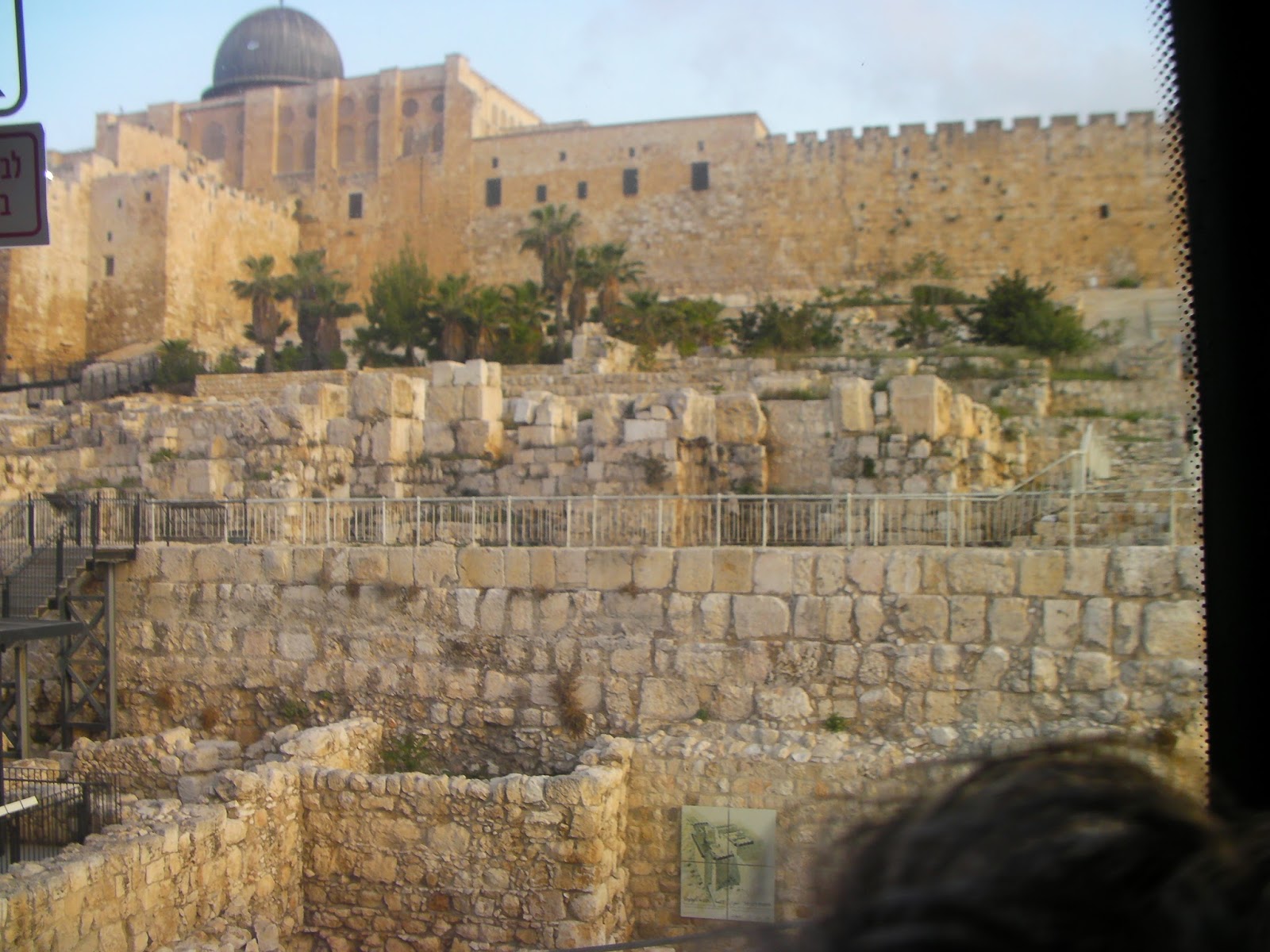
We see the walls of the Temple Mount, just like all the many pictures I have seen.
There are people and cars everywhere and interestingly enough, no special place for buses to pull off to the side and unload their passengers. We literally stop in traffic and we are told to quickly debus as the impatient drivers blare their horns from behind our bus. We don't make eye contact or even register that they are there. We have our listening devices on and strain to hear our instructions from our leaders over the din. This is the last place I want to get detached from the group. Indiana Jolie and I stick close together and close to our guides.
We quickly join some very long lines in front of some "gates" that look like something you would go through at an amusement park.
There are several lanes but we hug the one by a wall that is topped by a hedge of thick vegetation. Between us and the Temple Mount is an area that is hard to interpret. It looks like perhaps an area of archaeological significance but there is nothing to explain it to us.
We wait and wait in line for some time, passports close at hand as it looks like we will have to pass some security. Our guides are in consultation with the guards (it's hard to tell if they are Israeli or Palestinian) and slowly we begin to move. This area is on the western wall of the Temple Mount or in the same area as the "Wailing Wall". We find that our Jewish guides prefer to refer to it as the western wall. We get through the security checkpoint and are directed to enter a covered "catwalk" that transverses the area below us that looks like it is an archaeological area. There is some kind of construction going on and this catwalk is to accommodate we tourist types who wish to access the Temple Mount.
We gain some elevation inside the catwalk and can overlook the western wall where so many Jewish people pray.
We continue to walk uphill and soon we are going through an ancient stone doorway and are suddenly on the Temple Mount.
In this area, it is very park-like and strangely quiet.
There is a large stone courtyard in front and to the right and on the left, there are sitting areas and many Muslim women and children walking about. All of the women are dressed in headscarves and long wool coats that extend down to their ankles. They remind me of a style that triggers a thought. They look very much like what they wear on The Matrix movie. Yes, that is it.
The gold Dome of the Rock looms high over some trees and walls to our north and a very sinister looking black dome is in front of us to our east.
Nobody smiles at us or makes friendly eye contact. Our guides gather us and instruct us that we are explicitly told we are NOT to pray with our eyes closed or hands raised, we cannot have a Bible in sight, we cannot wear a cross on our person, we can not gather in a circle to pray or hold hands. In other words, anything that would identify us as a Christian is NOT welcome on the Temple Mount. In fact, we are told not to use the term "Temple Mount" as the Muslims deny this area ever had a Jewish temple on it and has no relationship to the Jews whatsoever.
The Muslims are such friendly people, I feel at ease and at home. Well, maybe not so much. This is such a contrast to the Jewish controlled areas. The Jewish people allow everyone and everything in terms of religion, what you are wearing or whatever it is you want to say. These Muslim areas of control are very tense which is something we will experience more of in the days to come. We don't need a lot of encouragement to stay with our group.
We pass in front of the building with the black dome. It has very tall wooden doors and three entrances.
We are told this is a mosque, actually three mosques, the reason for the three doors. It is dark, not inviting and sinister looking as if it was intended to be intimidating. Interesting enough, the Dome of the Rock is NOT a mosque which is what I have always assumed it was. The Muslim authorities change their mind frequently about allowing the public in and it is presently not open to the public. They are also doing some renovations on it as well.
As we walk toward the Dome of the Rock I notice the large number of Muslim men who are in these little study groups all over the place.
I want to look over their shoulders at the books they are holding, but don't want to push my luck. A white, 6'6" American dude doesn't just blend in here so I try not to attract any more attention than I already do.
There are more stairs (always more stairs) that take us up to the actual level that the Dome of the Rock is on. I am at once amazed at the immense size of the temple square, it is huge.
Many, many football fields could fit in this area. It is all stone tiles under foot and it stretches out in front of us for far longer than I ever noticed from pictures.
Our groups walk toward the eastern face of the Dome (which is the view you have probably seen in the pictures of Jerusalem taken from the Mt. of Olives). It is quiet here and fairly empty of people. We are given some instruction on the history of the Temple Mount and how it came to be in its present form. We are shown the Eastern Gate which some believe to figure in to biblical prophecy.
It is thought that when the Jewish Messiah comes, he will enter through this gate. Since the Muslims have had control of the Temple Mount, they walled up the gate to prevent this and to further prevent a Jewish Messiah from even wanting to enter through this gate, they have made a Muslim graveyard in front of it to defile it for a Jewish Messiah.
We are allowed to walk at will around the mount but I am not wanting to stray far.
One of our couple friends decided they wanted to take a "selfie" up close to the Dome of the Rock and they walk away from the main cluster of our group about 100 yards. On their way there, they were accosted by a Muslim man who was well versed in English curse words. He was riding his bike across the Temple Mount and spotted these American tourists by themselves. He dropped "f-bombs" liberally at the top of his lungs and expressed his hatred of Americans, Christians and Jews as he kept riding across the mount. Our friends were quite rattled by this and decided being with the group was a better idea.
As they rejoined the group I began to hear men shouting, "Allah Akbar! Allah Akbar!" over and over again. More and more men joined in the shout until you could hear it all over the Temple Mount. I wondered if the episode of the cursing riled all these Muslim men and they were on the war path. All of those Muslim study groups scattered everywhere on the mount stood up and were shouting this most familiar phrase associated with Islam. I was not feeling good about this as it kept going on and on, louder and louder. I am nervously eyeing our guides who do not seem to be concerned about this. I am wondering if we are going to be the subject of the evening news at home tonight. We all gather for a group photo.
Apparently, this is how they end their time of study of the Quran on the Temple Mount and everyone finally decided they had shouted it enough and all the groups dispersed. From the get-go I decided the Temple Mount was not a warm and cozy place. I don't care if I ever have the chance to go back to the Temple Mount which is what the people there hope I feel. I was done with the Temple Mount and we exited on the east side of the square down some stairs into a more garden, park-like area.
Just being off the Temple Mount felt better and people in this area looked more relaxed if not just as unfriendly.
I have to admit, the views of the Temple Mount / Dome of the Rock are "epic" without over using that word. The scale of the buildings and the length of the courtyard is grand, the gold dome (which is actual gold leaf) is quite a grand sight.
It is just really unfortunate that the atmosphere is intended to be so unwelcoming. It so contrasts to our way of life in the USA. Where we are so open, they are so very closed. It is a very double standard as they expect to be treated as equals and with respect, but do not give it whatsoever. Contempt is in every stare and anger is in every communication. At this point, we are easily encouraged to follow our guides through the "Lion's Gate" and further into the ancient city of Jerusalem.
It has been an interesting morning already.
Thursday, September 11, 2014
Thursday, September 4, 2014
Day 5 Part 3
Leaving the kibbutz, we boarded the buses and headed out of the busier sections of towns and cities to what seemed like the "country". Less traffic, smaller villages, less signs of civilization.
We turn off the main road to what looks like a tourist attraction with lots of parking lot spaces and some interesting looking buildings. This is Shiloh (she-low) at least that is the way our Israeli guide, Eli pronounced it. I was a little embarrassed for him but didn't want to tell him the correct pronunciation in front of everyone. Ahem, it's Shy-low, Eli.
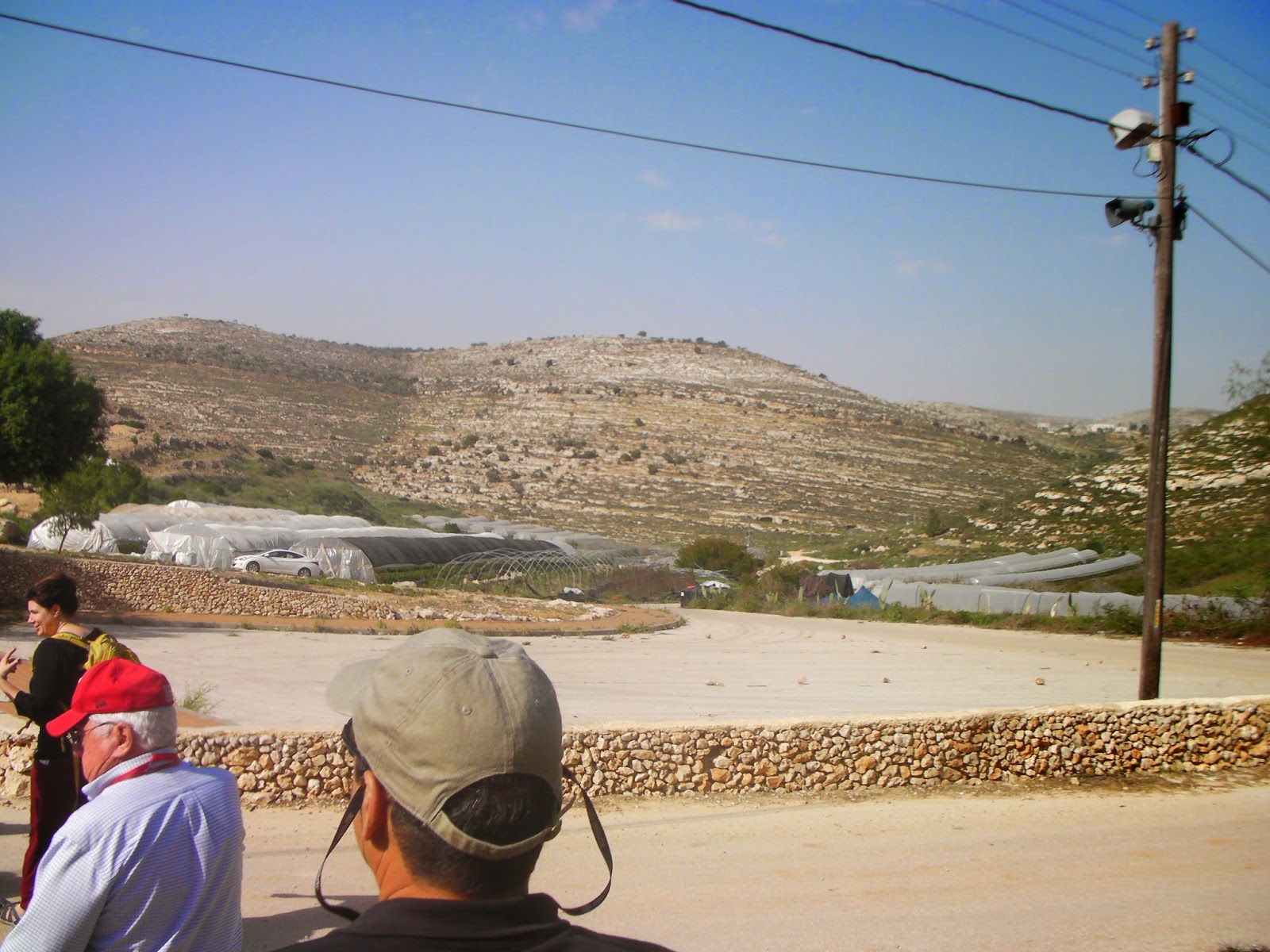
We are told that this part of Israel is dominated by Muslim people and there are times when there is "unrest" in this in this area. I look around and see the minarets in just about any direction I turn. Apparently the Muslims object to the Israelis finding anything that would authenticate any Jewish right or Jewish history connected to "Palestine". We are told that the moment the Muslims felt they could get away with it, they would abolish the entire site of Shiloh and destroy any work done here to say it never existed in the first place.
We turn off the main road to what looks like a tourist attraction with lots of parking lot spaces and some interesting looking buildings. This is Shiloh (she-low) at least that is the way our Israeli guide, Eli pronounced it. I was a little embarrassed for him but didn't want to tell him the correct pronunciation in front of everyone. Ahem, it's Shy-low, Eli.
We are told that this part of Israel is dominated by Muslim people and there are times when there is "unrest" in this in this area. I look around and see the minarets in just about any direction I turn. Apparently the Muslims object to the Israelis finding anything that would authenticate any Jewish right or Jewish history connected to "Palestine". We are told that the moment the Muslims felt they could get away with it, they would abolish the entire site of Shiloh and destroy any work done here to say it never existed in the first place.
For some reason, I was not thinking about the biblical village of Shiloh (duh!), but just kind of assumed this was just another archaeological site like we have been used to seeing daily since we have been in Israel. It is very desert like here, not a lot of vegetation, some short, skinny trees that look like they live a hard life.
We are introduced to one of the site archaeologists who is a relatively young man whose wife (we never did meet her) is the site's main archaeologist. He is quick witted, funny and has a real antagonistic kind of humor for our humble guide, Eli Sukron. He attempts to provoke Eli at every turn, but Eli isn't falling for it. The young man brags about some coins that he has recently uncovered and is very proud of. Eli looks at the coins and shrugs. He asks the young man how many coins he has found in his career as an archaeologist. "Around 30" the young man answers. Eli says when he finds as many as he has then he can have a right to brag. "How many have you found?" asks the young man. Eli nonchalantly says with a shrug, "over 3,000". We all laugh at the rivalry.
There are lots of rocks here, lots of shade trees and little sitting areas.
In the center of this whole place is a rather space age looking building.
It doesn't really "blend in" with the antiquity of the site, but is modern and nice. We are directed to ascend (more stairs, more climbing) the little hill and enter the modern looking building.
In the center of this whole place is a rather space age looking building.
It doesn't really "blend in" with the antiquity of the site, but is modern and nice. We are directed to ascend (more stairs, more climbing) the little hill and enter the modern looking building.
Once we are inside, it finally begins to dawn on me that this is ancient Shiloh, like where the tabernacle stood once the Children of Israel entered the Promised Land, that Shiloh. Now I get it. For some reason, I think it was the way they mispronounce Shiloh, and I also thought the actual site of the Old Testament Shiloh was lost and that no one knew where it actually was. Well, not only are they pretty sure this is the exact spot of the Old Testament Shiloh, but from the high place vantage of this building, you can look on the far side of the site and actually see the area they are quite confident where the tabernacle stood!
My mind is blown again, which is becoming a regular event on this trip. I am in Ancient Shiloh! The tabernacle of the wilderness wandering actually stood in this place. The high priest Eli lived here! The prophet Samuel and his mother, Hannah made pilgrimage to this spot. I am pondering all of this when we are introduced to a theater kind of room that is very "high tech". We sit in the theater seats that ascend from the floor level on up and are looking out a large window down on the actual site of the tabernacle. The room darkens and a projector from somewhere over our heads super imposes a colorful image over the area we are looking at so we now see the tabernacle site with it "filled in" as it may have looked in antiquity! We are seeing the tabernacle projected on to the window in such as a way as to see the "Tent of Meeting" down where there was nothing before.
It is so interesting to see reality transformed into this image right before our eyes without a curtain blocking the window and all.
There is a history and a drama that is shown with this background giving the story of Shiloh and how it was destroyed and left to ruin after the Israelites had forsaken God.
The show ends and a man comes out to address us and tell us further about the site. He tells us that many childless couples have been able to conceive after they had visited Shiloh. In fact, the very building we are viewing all this from is a result of a wealthy US couple who had come to Shiloh, prayed to have a child and after did have a healthy child born to them. They in gratefulness, donated some millions of dollars and had this center built to benefit the on-going archaeology in Shiloh. I ask Indiana Jolie if she wants to pray for more children. She declines.
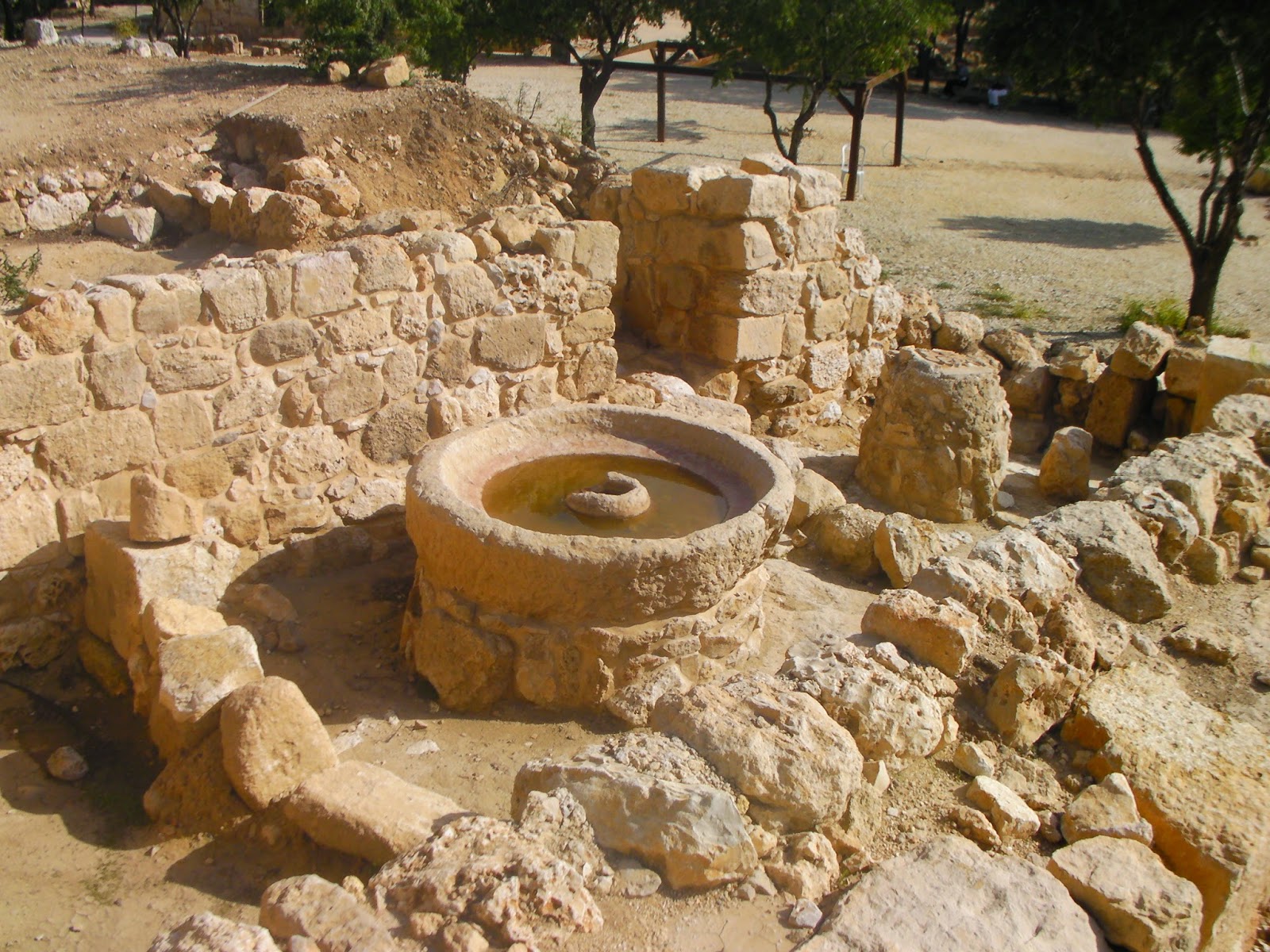
We exit the building and head on down to the tabernacle site. There isn't much to actually see except what they believe to be the outline of the tabernacle itself and a few excavated "pits" that have just recently been started.
They can only dig in the hottest months of the year because in the "rainy season" it becomes too difficult to manage all the water and mud that fills in the holes. They had not begun excavation while we were there as there was too much potential for rain yet. We have a short devotional here and some archaeological insights. One of the more interesting tidbits I learned was that the "tabernacle" did not remain a "tent" once it arrived in Shiloh. The need to make it mobile no longer existed so it became more permanent with rock (what else?) pillars and permanent roof. I had never heard this before. This is how it remained up until King Solomon's time. It is amazing to think that this very spot was the spiritual home for the ancient Israelis for 369 years.
We are allowed to wander the grounds which have numerous remnants of ancient buildings and rooms.
It is all fascinating. Indiana Jolie and I want to volunteer to be diggers in the excavations. Most volunteers however are relegated to more mundane tasks such as sifting and sorting and washing the lesser items of discovery and hauling off the loads of empty dirt. The real archaeologists want to make the important discoveries. Imagine that. I will only volunteer if it isn't a million degrees in the sun. Indiana Jolie doesn't care, she just wants to find something old in the dirt. We do find out that they only dig at the hottest times of year because there is no rain to wash mud into the excavations. We see evidence of this in some of the excavations.
We come around to a wider path that bisects the grounds. On the other side of Shiloh we see a gathering of people and wonder what is going on. We hadn't bothered to go on that side as it was more of the place where the mundane tasks seemed to take place such as the washing and sorting chores.
We arrive and our archaeologist Eli is there explaining about how dating on archaeological sites is done. An important tool in this is pottery. Apparently pottery was done very consistently through certain ages. It might have ridges in the sides of the pottery. Handles would have a certain size and shape or done in a specific manner. Due to the nature of pottery most of it is in shards. Eli is literally standing on a pile of pottery shards that span many different eras and centuries that have all be washed and thrown in this pile. He picks up several and tells us from what century they came from and other details that are important. I haven't seen so many pottery shards since the first day of our trip in Caesarea. Those pottery shards were still embedded in strata that had been exposed by excavation to show the many differing layers that had accumulated over the centuries. These were all mixed together after being processed and for lack of something better to do with them, thrown in a big pile.
Someone asks if it would be possible to have one of the pottery shards as a memento. The on site people seem to think this is no problem as they have more broken pottery pieces than they can handle and even if everyone took a piece, it wouldn't lessen the pile significantly whatsoever. In the crowd I as usual lose sight of Indiana Jolie. Especially in an archaeological site such as this I hardly ever even catch glimpses of her as she is snapping pictures of all the rocks.
The crowd surges to each take a pottery shard of their own to take home with them of this amazing site. I wait until the excited horde get their broken pottery before I think about taking a piece. As the crowd moves on, I spot Indiana Jolie on the pile of shards, digging furiously through pieces of pottery. I take one and wonder how old it is and meander off toward the buses as I am hoping there is some ice cream up where the offices are.
I buy something akin to a Dove Bar and happily begin to consume it. I wonder if Indiana Jolie would want one and wonder where she might be by now. I head back to the last place I saw her, the pile of pottery shards. I meet her about half way back and she has an excited gleam in her eye, in her hands and pockets she is carrying MANY pieces of broken pottery and asks me to help her carry these off. She has mostly pieces of pottery that were handles to pots and are a little more bulky that the plain pieces. She is hoping she doesn't get in trouble for taking so many, but after a hundred people carted of pieces I don't think it is a big deal.
She is so excited she can hardly contain herself and neither of us remember to take pictures. Actually our hands were too full of pottery and ice cream we couldn't have pulled out our camera if we had thought of it. Jolie thinks these pieces are wonderful and the thrill of the hunt for these special looking ones was as close to being a real digger on an archaeological site as she has ever been and as close to her dream of being the real Indiana Jolie. The other big deal is they came from what will be our favorite archaeological site of the whole trip. We place these pieces in our bags like treasure and head back to the buses. Only then does she notice that I am eating ice cream. She does want one.
The day is wearing on and the heat, many stairs and walking have their accumulative effect of wearing us out and we board our buses feeling a little tired but lifted by the valuable treasures we now possess and the ice cream bars. I take a long drink of lukewarm water and wish it would refresh me better than it does.
Our buses head toward Jerusalem. Highways are busier, more buildings begin to appear, traffic increases greatly, highway signs in Hebrew with arrows pointing to other destinations are more frequent. The pace of the world around us picks up considerably which is quite a switch from being in Galilee up to this point. We head into the city. We pass through a "check point" in the infamous wall between the Palestinian controlled areas and the Jewish controlled areas. It feels sinister. The guard towers have inches thick bullet proof glass. Machine guns are present everywhere. It reminds us that this region of the world is not like our region of the world. I am grateful.
Then suddenly, we are here. Jerusalem.
I wonder what wonders await us in this city which seems to be the center of the whole earth. We arrive at our hotel in the dusk of the day, our bags are unloaded and will be delivered to our rooms.
We are ushered to the dining rooms where huge, long tables are once again festooned with multiple layers of salads and vegetables, breads and cheeses. The hot buffets line the walls with their unfamiliar offerings of dishes. The room is loud with conversations in many languages and skins of differing colors. It is energizing to pick up our plates and begin to fill them with the new options. I seek out the dill pickles which have become my favorite item on the salad tables. It is hard to explain, but they are the BEST dill pickles I have ever had, a little less "bite" to them but all the great flavor and texture of a dill pickle. Makes me want one now as I think of them. I find them and fill my plate and eat them as I go so I can fill my plate again before I go and sit down.
We do sit down and feel the weariness of the long day. Once again, the planners of our tour have managed to pack so much into the day. We eat feeling the lift that food gives and have easy conversations with new friends we have met on our bus. I decide I have eaten enough and prepare to finish our conversations before I head up to our room. Someone walks by with what looks like a fabulous dessert. Dessert? Didn't see any dessert tables.
In the corner of the dining room is a dessert table. I arrive to a table that looks like it once held many choices of dessert but now only a lesser few choices remain with many crumbs and evidences of previous selections scattered across the table cloth. Obviously I have waited too long to visit this table, a mistake I will not make again.
They can only dig in the hottest months of the year because in the "rainy season" it becomes too difficult to manage all the water and mud that fills in the holes. They had not begun excavation while we were there as there was too much potential for rain yet. We have a short devotional here and some archaeological insights. One of the more interesting tidbits I learned was that the "tabernacle" did not remain a "tent" once it arrived in Shiloh. The need to make it mobile no longer existed so it became more permanent with rock (what else?) pillars and permanent roof. I had never heard this before. This is how it remained up until King Solomon's time. It is amazing to think that this very spot was the spiritual home for the ancient Israelis for 369 years.
We are allowed to wander the grounds which have numerous remnants of ancient buildings and rooms.
It is all fascinating. Indiana Jolie and I want to volunteer to be diggers in the excavations. Most volunteers however are relegated to more mundane tasks such as sifting and sorting and washing the lesser items of discovery and hauling off the loads of empty dirt. The real archaeologists want to make the important discoveries. Imagine that. I will only volunteer if it isn't a million degrees in the sun. Indiana Jolie doesn't care, she just wants to find something old in the dirt. We do find out that they only dig at the hottest times of year because there is no rain to wash mud into the excavations. We see evidence of this in some of the excavations.
We come around to a wider path that bisects the grounds. On the other side of Shiloh we see a gathering of people and wonder what is going on. We hadn't bothered to go on that side as it was more of the place where the mundane tasks seemed to take place such as the washing and sorting chores.
We arrive and our archaeologist Eli is there explaining about how dating on archaeological sites is done. An important tool in this is pottery. Apparently pottery was done very consistently through certain ages. It might have ridges in the sides of the pottery. Handles would have a certain size and shape or done in a specific manner. Due to the nature of pottery most of it is in shards. Eli is literally standing on a pile of pottery shards that span many different eras and centuries that have all be washed and thrown in this pile. He picks up several and tells us from what century they came from and other details that are important. I haven't seen so many pottery shards since the first day of our trip in Caesarea. Those pottery shards were still embedded in strata that had been exposed by excavation to show the many differing layers that had accumulated over the centuries. These were all mixed together after being processed and for lack of something better to do with them, thrown in a big pile.
Someone asks if it would be possible to have one of the pottery shards as a memento. The on site people seem to think this is no problem as they have more broken pottery pieces than they can handle and even if everyone took a piece, it wouldn't lessen the pile significantly whatsoever. In the crowd I as usual lose sight of Indiana Jolie. Especially in an archaeological site such as this I hardly ever even catch glimpses of her as she is snapping pictures of all the rocks.
The crowd surges to each take a pottery shard of their own to take home with them of this amazing site. I wait until the excited horde get their broken pottery before I think about taking a piece. As the crowd moves on, I spot Indiana Jolie on the pile of shards, digging furiously through pieces of pottery. I take one and wonder how old it is and meander off toward the buses as I am hoping there is some ice cream up where the offices are.
I buy something akin to a Dove Bar and happily begin to consume it. I wonder if Indiana Jolie would want one and wonder where she might be by now. I head back to the last place I saw her, the pile of pottery shards. I meet her about half way back and she has an excited gleam in her eye, in her hands and pockets she is carrying MANY pieces of broken pottery and asks me to help her carry these off. She has mostly pieces of pottery that were handles to pots and are a little more bulky that the plain pieces. She is hoping she doesn't get in trouble for taking so many, but after a hundred people carted of pieces I don't think it is a big deal.
She is so excited she can hardly contain herself and neither of us remember to take pictures. Actually our hands were too full of pottery and ice cream we couldn't have pulled out our camera if we had thought of it. Jolie thinks these pieces are wonderful and the thrill of the hunt for these special looking ones was as close to being a real digger on an archaeological site as she has ever been and as close to her dream of being the real Indiana Jolie. The other big deal is they came from what will be our favorite archaeological site of the whole trip. We place these pieces in our bags like treasure and head back to the buses. Only then does she notice that I am eating ice cream. She does want one.
The day is wearing on and the heat, many stairs and walking have their accumulative effect of wearing us out and we board our buses feeling a little tired but lifted by the valuable treasures we now possess and the ice cream bars. I take a long drink of lukewarm water and wish it would refresh me better than it does.
Our buses head toward Jerusalem. Highways are busier, more buildings begin to appear, traffic increases greatly, highway signs in Hebrew with arrows pointing to other destinations are more frequent. The pace of the world around us picks up considerably which is quite a switch from being in Galilee up to this point. We head into the city. We pass through a "check point" in the infamous wall between the Palestinian controlled areas and the Jewish controlled areas. It feels sinister. The guard towers have inches thick bullet proof glass. Machine guns are present everywhere. It reminds us that this region of the world is not like our region of the world. I am grateful.
Then suddenly, we are here. Jerusalem.
I wonder what wonders await us in this city which seems to be the center of the whole earth. We arrive at our hotel in the dusk of the day, our bags are unloaded and will be delivered to our rooms.
We are ushered to the dining rooms where huge, long tables are once again festooned with multiple layers of salads and vegetables, breads and cheeses. The hot buffets line the walls with their unfamiliar offerings of dishes. The room is loud with conversations in many languages and skins of differing colors. It is energizing to pick up our plates and begin to fill them with the new options. I seek out the dill pickles which have become my favorite item on the salad tables. It is hard to explain, but they are the BEST dill pickles I have ever had, a little less "bite" to them but all the great flavor and texture of a dill pickle. Makes me want one now as I think of them. I find them and fill my plate and eat them as I go so I can fill my plate again before I go and sit down.
We do sit down and feel the weariness of the long day. Once again, the planners of our tour have managed to pack so much into the day. We eat feeling the lift that food gives and have easy conversations with new friends we have met on our bus. I decide I have eaten enough and prepare to finish our conversations before I head up to our room. Someone walks by with what looks like a fabulous dessert. Dessert? Didn't see any dessert tables.
In the corner of the dining room is a dessert table. I arrive to a table that looks like it once held many choices of dessert but now only a lesser few choices remain with many crumbs and evidences of previous selections scattered across the table cloth. Obviously I have waited too long to visit this table, a mistake I will not make again.
Subscribe to:
Posts (Atom)